



- This event has passed.
ETIS seminar: Claudia Paris
Title: Integrating multimodal satellite data, ground-based field photos and AI to go beyond traditional mapping.
Abstract
Increasingly frequent extreme weather events and climate change pose growing threats to human well-being and ecosystem health. To monitor and assess environmental change and land degradation (e.g., deforestation, desertification, urban expansion), satellite data can be leveraged for the regular production of land-cover maps that capture dynamics across the Earth’s surface. These data have been widely used to generate consistent, large-scale land-cover information over time, enabling monitoring at regional to global scales.
With rapid advancements in Earth Observation technologies and computational capabilities, there is now an opportunity to move beyond traditional land-cover mapping toward more comprehensive and actionable characterizations of landscape dynamics. In particular, the increasing availability of crowdsourced, geo-tagged field photos introduces an additional and complementary data source. When integrated with satellite imagery, these data enable richer, multi-dimensional representations of land systems.
This integration allows information to be captured at multiple levels of semantic detail, which is essential for understanding complex and heterogeneous landscapes. While satellite image time series provide valuable temporal information on land-cover dynamics, ground-level photos offer fine-grained spatial detail and contextual insights into local conditions, such as vegetation structure, land management practices, disturbance events, and small-scale landscape features that are difficult to observe from space.
Recent advances in Artificial Intelligence (AI), particularly in visual-language models, self-supervised learning, and multimodal approaches, create new opportunities to effectively combine satellite and ground-based data. The integration of geo-tagged field photos, satellite image time series, and AI methods enables more detailed and scalable interpretation of land-cover patterns and processes, supporting improved detection and understanding of environmental changes that were previously difficult to capture.
Bio
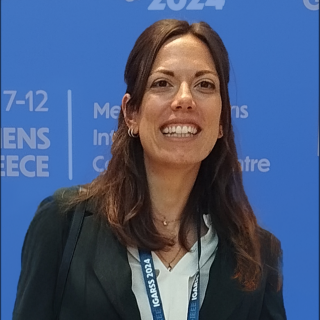
Claudia Paris is a Senior Assistant Professor (UD1) in the Faculty of Geoinformation and Earth Observation Sciences (ITC) at the University of Twente, Enschede, the Netherlands. She received the “Laurea” (B.S.), the “Laurea Specialistica” (M.S.) (summa cum laude) degrees in Telecommunication Engineering and the Ph.D. in Information and Communication Technology from the University of Trento, Italy, in 2010, 2012, 2016, respectively. She accomplished the Honors Master Program in Research within the Master’s Degree in Telecommunication Engineering in 2012. Claudia Paris’ research encompasses image processing, signal processing, pattern recognition, machine learning, and deep learning, specifically applied to remote sensing image analysis. She focuses on designing innovative and automated workflows for the analysis and classification of large-scale Earth Observation (EO) data for various applications (e.g., forest/agricultural mapping and monitoring) by leveraging high-performance computing (HPC) and cloud computing platforms (Google Earth Engine). Her main research interests focus on the classification and fusion of multisource remote sensing data, multitemporal image analysis, domain adaptation methods, and land cover map updates. She has been conducting research on these topics in the framework of national and international projects. She is a member of the scientific and programme committee of the IEEE International Geoscience and Remote Sensing Symposium (IGARSS) and the SPIE International Symposium on Remote Conferences, respectively, and is also a referee for several international journals. Dr. Paris was twice the recipient of the prestigious Symposium Prize Paper Award (exceptional paper in terms of content and impact on the Geoscience & Remote Sensing Society) at the 2016 IEEE IGARSS (Beijing, China, 2016) and at the 2017 IEEE IGARSS (Fort Worth, TX, USA, 2017). She also won the IEEE Geoscience and Remote Sensing Society 2022 Letters Prize Paper Award (exceptional paper in terms of content and impact on the GRS-Society).
Place: online (link to be shared)